The Root of Addiction: Why Healing Starts With Connection
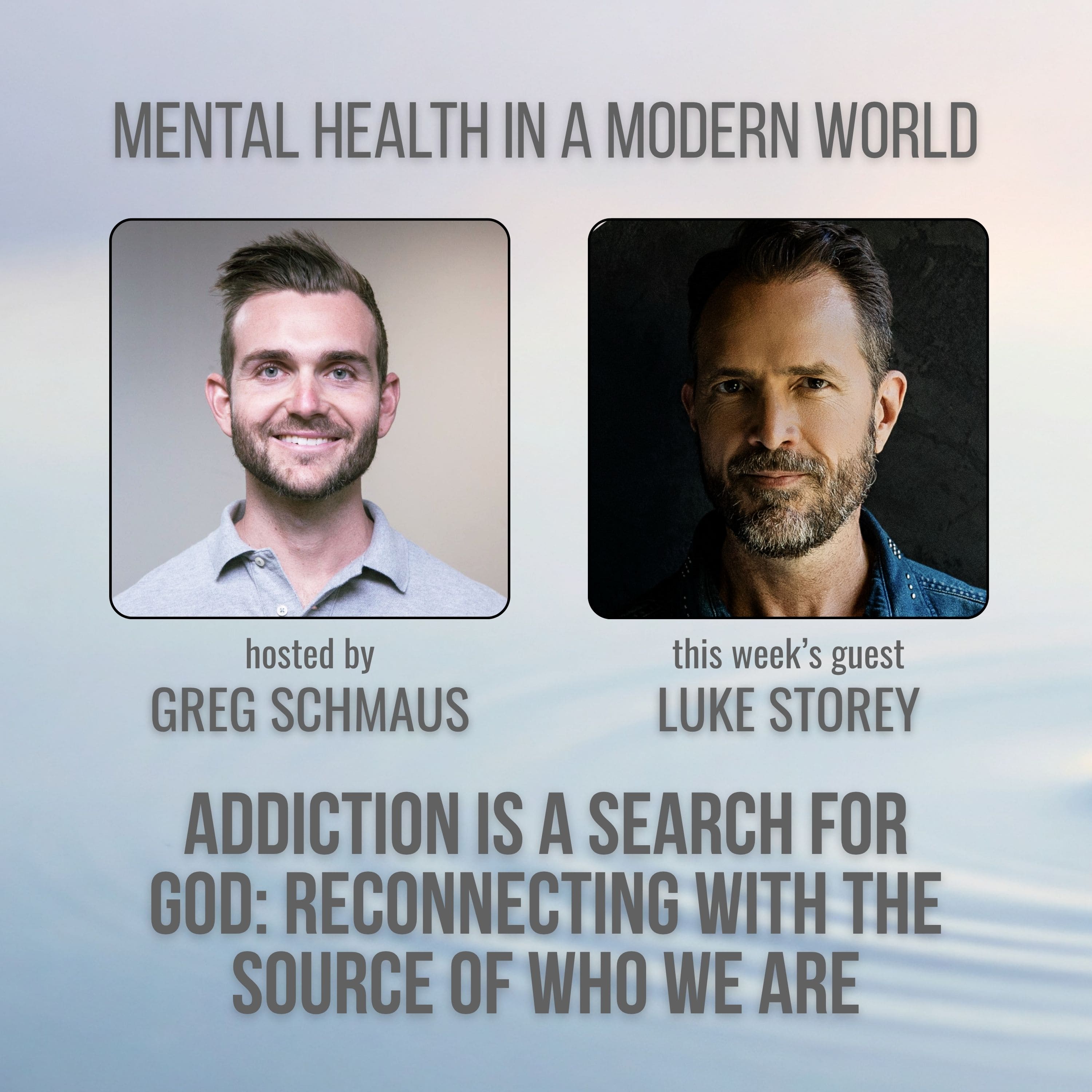
What if your addiction is not the real problem, but your best attempt at solving one? Many of us were taught to fight the behavior and treat the drink, the drug, or the phone as the enemy. But beneath the craving there is often a quieter ache: the feeling of being alone and cut off from something essential. On Mental Health in a Modern World, holistic health practitioner Greg Schmaus sat down with author Luke Storey to explore the root of addiction and the deeper path to healing it.
From Hollywood Chaos to Nearly Three Decades of Recovery
Luke Storey grew up in the San Francisco Bay Area in the 1970s and 1980s, where drugs were easy to find. He describes coming from “a lineage of a lot of very hurt people.” His parents and grandparents loved him, but his family system made childhood hard. Addiction became how he adapted, and it started young. As a teenager, he spent two years in what he calls a very cultish troubled teen program. It gave him help he badly needed, along with some psychological harm. He got sober there but left at 16 with no tools to stay that way. What followed was a 10-year spiral that ended in Hollywood. At first, playing in bands and running with “the other black sheep” felt like belonging. Over time, it became a place of lost souls. At 26, the wheels came off. He entered treatment in 1997, and that began a journey of healing and self-discovery he is still on today.
Physical Sobriety Is Only the Beginning
Luke uses a saying from recovery circles to explain this:
“What do you get when you sober up a horse thief? The answer is you have a sober horse thief.” Luke Storey
Getting physically sober does not restore your character on its own. In Luke’s view, physical sobriety is what makes the deeper work possible. The real goal of recovery is a spiritual awakening. Staying sober becomes a byproduct of that awakening.
The Wound of Separation Starts Early
Greg pointed to the work of Jungian psychotherapist James Hollis. In the womb, we are one with our mother, much like a soul is one with source before it is born. Birth is the first experience of separation, so the mother comes to stand for source in the child’s world.
Luke opens his new book with this exact theme. He describes a core abandonment wound that formed before he could speak. Because of the circumstances of his birth, he spent about his first week of life in an incubator in the NICU. He was not breastfed, held, sung to, or given eye contact.
He does not see himself as a victim of that. He is grateful to be alive. But he believes those early hours and weeks shape how easily we bond, feel safe, and connect with others for the rest of our lives. He also points to the mother’s environment during pregnancy, including stress, substance use, and violence, as part of that picture.
Greg added that in his own life and in his work with clients, an attachment injury with the mother has been perhaps the number one source of addictions he has seen.
Surrender as the Path to Healing Addiction
If the root problem is separation, willpower alone stands little chance. Luke says the only thing that has ever worked for him is self-honesty and accepting that he cannot change it by himself. He needed a greater source of power.
Greg shared an insight from a recent ceremony: perhaps there is no such thing as personal power, only spiritual power. Seen this way, it is not that you let the addiction go. The addiction lets you go once you align with that source.
What God Means to Luke Storey
Luke was not raised with religion. When he was about eight, his mother took him to the ashram of a mystic named Muktananda, and he has felt drawn to Eastern mysticism ever since. Across every tradition he has explored, he keeps returning to the same core principles that first launched his journey through the 12 steps.
Today, he describes God as consciousness and awareness, present in everything. He offers a simple picture: if you told a fish there was something all around it called water, the fish might not believe you. For Luke, healing has meant living more and more aware of the water.
In practice, this looks like:
- Noticing when fear or false ideas start to take over his mind
- Making small, moment-to-moment surrenders rather than forcing his way through
- Asking “What’s in the way?” when he feels disconnected, instead of striving harder
- Taking the next indicated step, guided by a spiritual principle
The Gap Between Trigger and Reaction
One of the most practical parts of the conversation is how Luke handles being triggered. Years ago, if someone cut him off on the freeway, he would explode into road rage with no self-awareness.
Now he can feel his nervous system activate and notice his survival instinct sending a message to “hurt them back.” Thanks to years of meditation, he has come to know the gap between a trigger and his response. That gap is where choice lives.
He calls the part of him that watches this happen the witness observer, “the adult in the room.” Greg connected this to parts work, where we learn to notice the inner critic, the negotiator, or the perfectionist without becoming them.
Codependence vs. Interdependence
Greg shared something one of his teachers says: the universe is intimate, not personal. The less personally we take things, the more intimate a relationship can become.
Luke describes the difference this way:
- Codependence is give and take, attack and defend. One person’s feelings depend on the other’s, and there is little room for each to have their own experience.
- Interdependence means each person takes responsibility for how they feel. The relationship becomes a shared “third entity” that both people contribute to.
He also admits he does not always get it right. Once, wanting his wife’s approval, he skipped his morning meditation to hold space for her. He felt thrown off balance afterward. He now sees that taking a few minutes to center himself first is not selfish. It lets him show up better for her.
Being Gentle With the Habits We Still Carry
Luke is open about using nicotine pouches and having been addicted to nicotine for about 40 years. He has tried to quit and found that he simply feels better with it.
The real struggle, he says, is the “spiritual perfectionism” it stirs up, the inner voice saying he should have outgrown it by now. Greg named it simply: it activates the inner critic. Luke’s question for himself is a kind one: how can he love himself, even in that relationship?
The Circles of Boundaries
Luke pictures his life as a set of circles. The inner circle is sacred, holding himself, God, his wife, and close friends and family. At the outer edge is a “do not cross” zone, which for him includes pornography, cocaine, heroin, crystal meth, and alcohol.
When it comes to substances that once ruled his life, he says he has been placed in a position of neutrality. There is no fight and no temptation. To him, that is the sanity promised in the 12 steps.
Psybriety: A Personal and Carefully Held Story
After 20 years of abstinence-based recovery, Luke was still stuck in his romantic relationships, despite trying almost every healing modality he had heard of. He began meeting people for whom psychedelics had been deeply transformative, including some who had found sobriety that way.
He coined the word “Psybriety” to describe the ceremonial, intentional, and responsible use of plant medicines alongside sobriety. Luke is careful to say this is only his story, not a recommendation. He respects traditional abstinence-based recovery, and he notes that a few substances can be risky for people prone to addiction.
Numb vs. Free
Asked how a medicine differs from a drug, Luke says much of it comes down to whether it numbs you or frees you. In his experience, psychedelics act like a magnifying glass on your problems rather than a way to escape them.
During his first ayahuasca ceremony, at 20 years sober, he wondered whether he was still sober. The answer he received has stayed with him:
“Luke, you have never been more sober in your entire life as you are in this moment.” Luke Storey, recalling his first ceremony
He also stresses caution. He turned down most invitations, often checking in with his wife’s intuition first. He describes these experiences as taxing on the nervous system, and today he says he is not seeking them out.
You Are Never Truly Alone
Luke closes with the heart of his message:
“No matter how alone you feel or have ever felt, it is literally impossible, factually impossible, scientifically impossible to be alone.” Luke Storey
If you feel alone, he invites you to ask why. What blocks are creating the illusion of separation between you and your life? He suggests the spiritual path is a journey of remembering the oneness we came from, and that the challenges of being human are perfectly designed to help the soul grow.
H2: Key Takeaways
- Look beneath the behavior. Addiction is often an attempt to solve a deeper pain, such as loneliness or separation. Ask what you are trying to escape or reach for.
- Treat sobriety as a doorway, not the finish line. Removing the substance makes deeper healing possible, and real change comes from living by spiritual principles.
- Practice the pause. Meditation can widen the gap between a trigger and your reaction, giving you more choice in how you respond.
- Build interdependence, not codependence. Take responsibility for your own feelings, and take a few minutes to center yourself before holding space for someone else.
- Meet your lingering habits with compassion. Notice when the inner critic or spiritual perfectionism shows up, and ask how you can love yourself even there.
Continue Your Healing Journey
If Luke Storey’s story speaks to you, his book, “A Horse Named Lonesome,” explores loneliness, separation, and connection through his own life. You can learn more at ahorsenamedlonesome.com, and Luke encourages buying it from your local bookshop.
To keep exploring holistic approaches to mental health, follow Mental Health in a Modern World with Greg Schmaus. New episodes come out every Friday, with solo insights, conversations with leading voices in holistic healing, and live coaching sessions. If you are ready for deeper support, consider working with Greg directly. His integrated approach combines lifestyle coaching, psychoemotional healing, mindfulness, and archetypal work.