Your Mindset Is the Story You Tell Yourself: How to Rewrite It
Have you ever noticed the same painful pattern showing up in your life again and again? Maybe it’s the same kind of relationship or the same old fear. You may know exactly where it comes from and still feel stuck. What if the way out is simpler than you think, as simple as the words you use and the way you breathe?
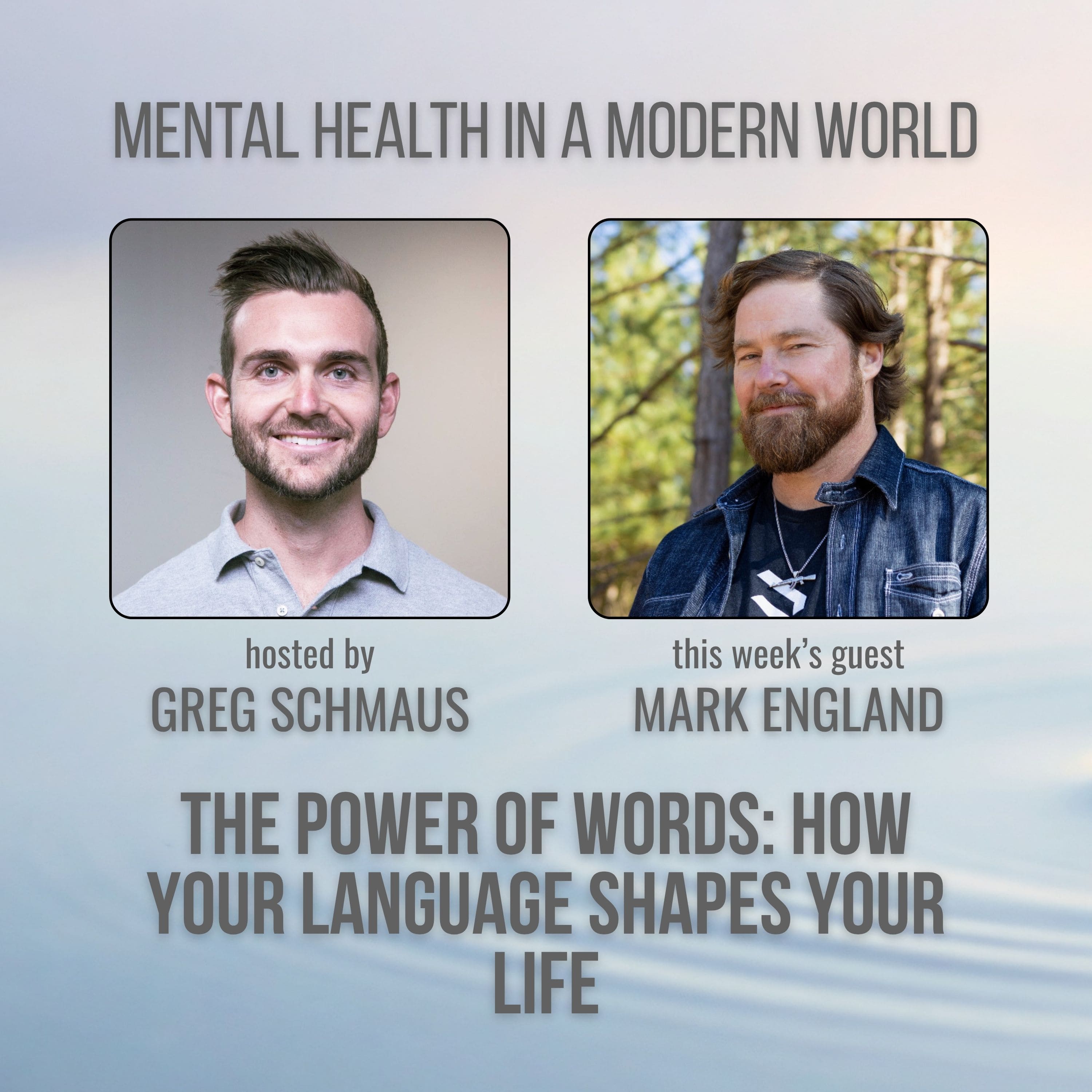
On Mental Health in a Modern World, host Greg Schmaus spoke with Mark England about how stories shape our inner lives. Mark offers a clear, hopeful way to work on your mindset without making it complicated.
What Is Mindset, Really?
There are many definitions of mindset. Some, like the American Psychological Association’s version, are long and hard to follow. Greg Schmaus admitted one of them gave him a headache.
Mark England’s definition is much simpler:
“Your mindset is the story that you tell yourself, and that story is made of words and breath.”
This matters because, in Mark’s words, when you know what something is and what it’s made of, you have a good chance of working on it. You can’t easily change a vague “mental attitude.” You can change a sentence, and you can change how you breathe.
Why Simple Beats Complicated
Many of us believe that big, complicated problems need big, complicated answers. Mark disagrees. He estimates that about 85 percent of the time, the answer is something simple.
He’s also honest about why he once resisted simple answers. He wanted his problem to be complicated so he could have a special problem. He wanted it to be special because he wanted to be special. That kind of honesty is part of what makes this approach work.
From Fighter to Mindset Coach
Mark England took his first jujitsu class in 1996 and fell in love with it immediately. He competed in kickboxing and early mixed martial arts on the East Coast. In February 2002, he moved to Thailand for what he planned as one year. It turned into ten.
Six months in, he had his second knee surgery. The doctor told him his fighting career was over. Mark says he fell into a deep victim mentality. He saw the injury as final proof of a case he had secretly been building against himself: that he wasn’t good enough. He didn’t laugh for an entire year.
The Workshop That Changed Everything
In 2003, Mark went to a spa in Thailand for a cleanse. While there, he attended an emotional detoxification workshop led by Barry Musgrave. He admits he laughed at the title at first.
Then he watched a woman share the story of a painful, public breakup. Her boyfriend had cheated on her in front of everyone and then dumped her in front of everyone. The sentence holding her story together was, “He did that to me.”
Barry asked her to change one word. “He did that to himself.” At first she said it like a question. Then her breath unlocked. She realized he had lost friends and that it was worse for him in the long run. She walked out of that room, Mark says, “with a different face.”
Mark studied this work for four years and has been doing it full-time since January 2007.
Why We Keep Repeating the Same Patterns
Greg Schmaus asked a question many of us wonder about. Why do we keep recreating painful experiences through new relationships and situations?
Mark’s answer is direct. We repeat the same stories because we use the same words.
“If you want different stories, you’re gonna need different words.”
He points out that the phrases we use for growth all come down to this. “I changed my mind.” “I see things differently now.” “I had a cognitive shift.” In each case, you’re using different words.
One Woman, Five Relationships, One Sentence
Mark shared the story of a client who said, as soon as she sat down, “I’ve had the same relationship with five different men, and I know where it’s coming from.” She believed it traced back to her father.
She wrote out specific memories of her parents’ worst fights. One sentence stood out: “If my father had loved us more, everything would’ve been different.”
Mark points out what often follows a sentence like that, something like, “If I had been better, he would’ve loved me more.” Children often make adults’ problems about themselves.
They changed the sentence one step at a time:
- “If my father had loved us more, everything would’ve been different.”
- “If my father had loved himself more, everything would’ve been different.”
- “If my father had loved himself more, he would’ve been different.”
The story moved from personal to impersonal, from “something to do with me” to “nothing to do with me.” She had never put those words together before. After a lot of tears, she left breathing much better.
Stories in Your Head vs. Stories on Paper
This may be the most useful idea from the conversation. Mark explains that stories kept in your head behave very differently from stories written down.
Stories kept in the head tend to be:
- Disorganized, made of snippets of words and flashes of pictures
- Fast
- Repetitive, almost endless
- Tied to breath trapped in the chest
Stories written down are:
- Organized, with a first word and a last word
- Finite
- Outside of you, where you can see them
- Still, not moving
The Speed of a Story Matters
Mark says that if you take just one thing away, let it be this:
“The faster the story goes, the harder it is to change.”
And the fastest way to slow a story down is to write it down.
You can see this in everyday life. When someone is upset and talking a mile a minute, they can’t really hear you. Their breath gets tight and their focus narrows. Mark compares it to sprinting. On a slow walk, by contrast, your vision opens up, your breath deepens, and your body loosens.
The Four-Step Method for Rewriting Your Story
At Enlifted, Mark’s coaching organization, the main tool is called four-stepping stories. Mark sums up their work in one sentence: they four-step stories and they play with words.
Here’s how it works:
- Title it and write it out. Pick one specific memory. Write it in full sentences with punctuation, erring on the side of more detail. Write it conversationally, like you’re telling a good friend what happened. This is different from general journaling.
- Read it out loud.
- Read it slowly. Slow down to about 70 percent of your normal speaking speed.
- Read it slowly with breath. Take a full breath in and a full breath out between each sentence.
As the breath loosens and drops lower in the body, Mark says, the picture zooms out. You move from living the story to observing it. Enlifted calls that shift, from participant to observer, a breakthrough.
Not Just for Painful Stories
Four-stepping isn’t only for hard memories. Mark notes that we keep our scary stories up close and loud, while our good stories, the times people showed up for us or we did something great, feel far away and quiet.
Writing out your wins and reading them with breath helps turn up the volume on what went right. Mark’s suggested order: clean up the house, then throw the party. Work through the scary stories first, then celebrate the good ones.
The “Should Detox” and Other Word Games
Enlifted has many language games. When the organization polled the roughly 570 coaches it has certified, 84 percent picked the “should detox” as their favorite.
Here’s how it goes:
- Start with a “should” sentence: “I really should ask my girlfriend to marry me.”
- Replace “should” with “could”: “I could ask my girlfriend to marry me.”
- Replace “could” with “can”: “I can ask my girlfriend to marry me.”
- Add “because” to find your reason.
In Mark’s story, a man who ran this exercise added that he and his girlfriend had been together three years, it kept getting better, and he couldn’t see himself with anyone else. He proposed that weekend.
Escaping the Victim-Villain Picture
Mark shared another simple swap. Saying “She’s wasting my time” creates a victim-villain picture where you wait for the other person to change. Saying “I’m wasting my time” takes them out of the picture. Now it’s just you, and you can do something about it.
Why Your Breath Is the Missing Piece
Greg Schmaus noted that many people treat stories as purely mental. Mark’s approach brings the body in. Greg asked whether a new story becomes real when the body believes it. Mark agreed: that’s when it gets taken to heart.
Mark puts it this way. Feelings and emotions plus breath trapped in the chest lead to the same thing going around and around, like a revolving door. Feelings and emotions plus breath low and slow lead to evolution. The thing actually changes.
A Simple Fix for Affirmations
If affirmations have never worked for you, Mark has one suggestion: take a breath between each one. When your breath is trapped in your chest, even the best words stay a mental exercise.
You’ll know a new belief has landed, he says, when you can say it and your body is as relaxed as when you’re talking about your breakfast.
Greg Schmaus connected this to how the nervous system works. When we’re in fight or flight, something new feels like a threat, so we go back to old programs. When we’re regulated and calm, we’re open to change. Mark calls breath “the bouncer and the door.”
The “Original Sin” of Mindset Coaching
For coaches, healers, and anyone who supports others, Mark names what he calls the original sin of mindset coaching: thinking you have to have all the right answers for your clients. He’s quick to say he has made every mistake he describes.
Believing you need all the answers:
- Kills curiosity, because you’re just waiting to respond
- Opens the door to imposter syndrome
- Creates stress that traps your own breath
- Leads to drama bonding, where you believe and get pulled into a client’s story
His advice to students:
“Do not believe your client’s story. Observe your client’s story.”
Answers Push, Questions Pull
Mark describes a coaching quadrant built on two things: how you breathe and whether you give answers or ask questions.
- Chest breathing plus answers: the most common form and the least effective
- Chest breathing plus questions: a big improvement and the easiest switch to make
- Relaxed breathing plus answers: the guru approach
- Relaxed breathing plus questions: the most effective and the rarest
When a coach stays calm and curious while a client is falling apart, Mark says the message underneath is, “I’m okay with you not being okay.” That alone can be healing.
Greg Schmaus added a powerful reflection. Much of what hurts us came from moments when someone wasn’t curious about us, wasn’t tuned in to us, and wasn’t regulated around us. A coach who listens, stays curious, and breathes well gives people exactly what they were missing.
The Rescuer Trap
Greg shared an insight from his own shadow work. When he was desperate to change a client, he was often working through his own material through them. And if he took on the rescuer role, he tended to attract people in the victim role.
He put it simply: there is a very fine line between rescuer and perpetrator. If you need someone to stay a victim so you can save them, you keep them stuck. Mark said he would be thinking about that one long after the conversation.
Mark also offered a word swap for worried coaches. Change “I’m responsible for my clients” to “I’m responsible with my clients.” Notice how different that feels.
Key Takeaways
- Your mindset is the story you tell yourself, made of words and breath. Work on both.
- Write your hardest stories down. Written stories are slower, calmer, and easier to change than the ones racing through your head.
- Try the four steps: title and write it out, read it aloud, read it slowly, then read it slowly with a full breath between sentences.
- Play with one word at a time. Swap “should” for “could” and “can,” or “me” for “himself,” and notice how your body responds.
- Breathe between affirmations. A new belief has landed when you can say it as calmly as you’d talk about breakfast.
A Hopeful, Simple Path
Mark England’s message is hopeful. You don’t need a PhD to pick up a pen and face the stories that scare you. You need some courage. As he says, it isn’t always easy, and you’ll probably cry. But your breath can unlock, and you get the chance to tell yourself a different story.
If this resonated with you, subscribe to Mental Health in a Modern World for more conversations on holistic healing and personal transformation. If you’re ready to go deeper with your own mental health, consider working one-on-one with Greg Schmaus. And if you’d like to explore Enlifted’s coaching or certifications, visit enlifted.me or find them on Instagram at @enliftedcoaches.